Facebook marketing works best when it is treated as a system rather than a collection of random posts or isolated advertisements.
A small business needs to know who it is trying to reach, what it wants people to do, which type of Facebook activity supports that goal, and how it will learn from the results. Organic content and paid advertising can work together, but they are not the same activity and should not be managed as if they were.
This guide explains the main parts of a practical Facebook-marketing system, how to choose between organic and paid activity, what to measure, and when to move from one stage to the next.
Facebook does not guarantee reach, engagement, leads, or sales. Results depend on the audience, offer, content, setup, budget, timing, competition, and other factors.
What Facebook Marketing Includes
Facebook marketing generally combines two connected routes:
- Organic marketing — publishing content, responding to people, participating in relevant conversations, and building an audience without paying for each impression.
- Paid advertising — using Meta’s advertising tools to reach selected audiences and optimize campaigns for a specific business outcome.
These routes support different jobs.
Meta’s own Q4 2025 reporting illustrates why organic and paid Facebook activity should be evaluated separately. The two systems use different mechanisms and different performance metrics, as described in Meta’s Q4 2025 ranking update.
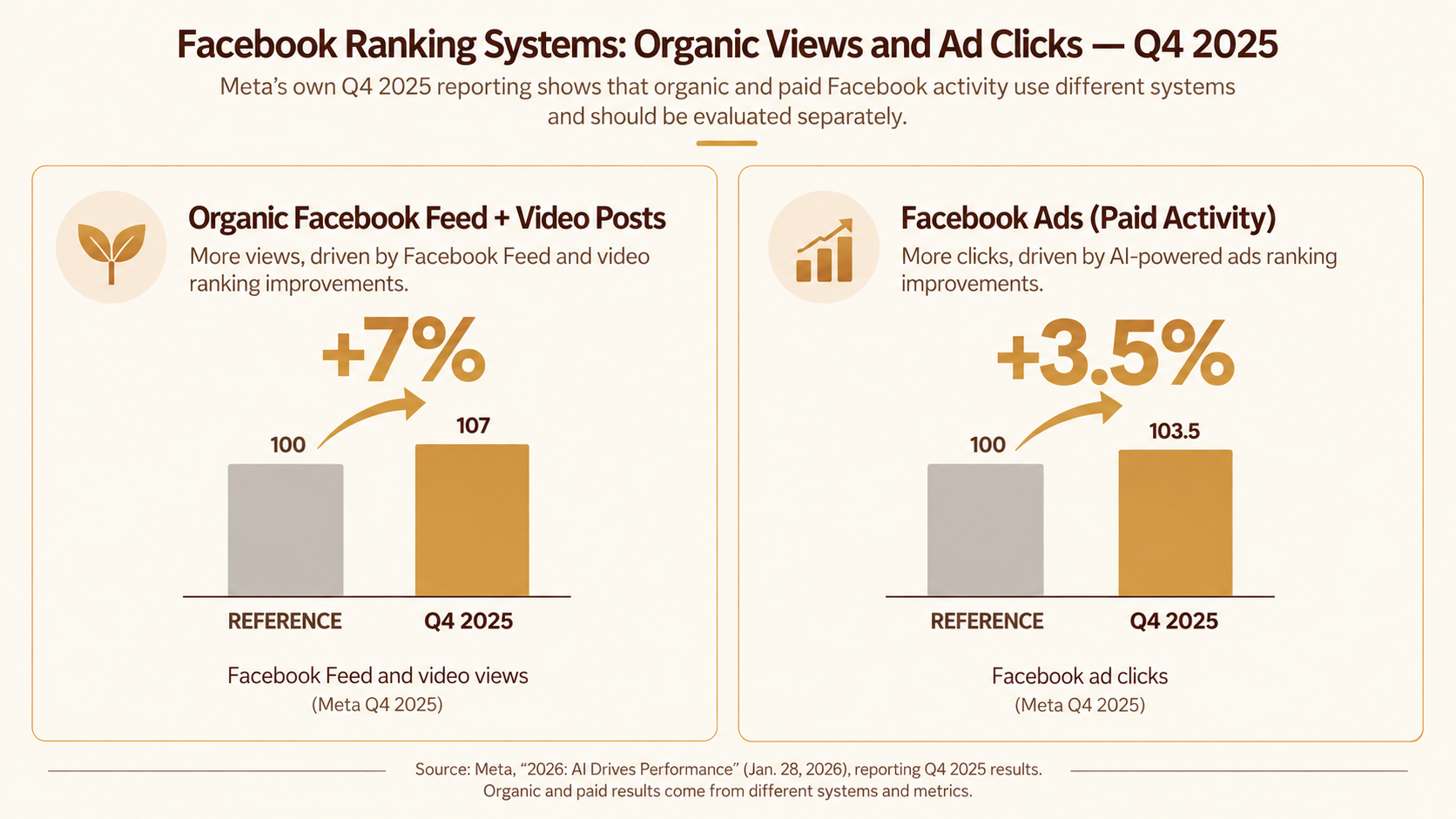
Organic activity can help a business demonstrate its expertise, answer questions, build familiarity, and learn what its audience cares about. Paid activity can help a business reach a defined audience with more targeting and delivery control, test an offer, or direct people toward a specific action.
The best choice depends on the business objective. A company trying to build familiarity may need useful organic content first. A company with a validated offer and a clear landing page may be ready to test paid traffic. Many businesses eventually use both.
Start with the Business Goal
Before creating a post or campaign, define the result that matters.
Possible goals include:
- helping more people discover the business
- increasing meaningful engagement
- sending visitors to a website or product page
- collecting qualified leads
- starting conversations
- selling a product or service
- learning which message or offer attracts the right audience
A goal should describe an observable business action rather than a vague desire to “go viral.”
For example:
- Weak goal: Get more attention on Facebook.
- Clearer goal: Reach potential customers who may need this service and encourage them to visit the consultation page.
- Weak goal: Increase engagement.
- Clearer goal: Publish useful answers that generate relevant comments and reveal the audience’s most common questions.
Meta’s current Ads Manager guidance organizes campaigns around objectives such as Awareness, Traffic, Engagement, Leads, App promotion, and Sales. The objective should match the action the campaign is designed to encourage, not simply the metric that looks most impressive.
Choose the Right Audience
A Facebook strategy becomes less useful when it tries to speak to everyone.
Start by describing the audience in practical terms:
- What problem are they trying to solve?
- What level of knowledge do they already have?
- What alternatives are they considering?
- What makes them hesitate?
- What language do they use when describing the problem?
- What action would be realistic for them to take next?
A small business does not need a perfect audience profile before publishing. It does need a working hypothesis that can be improved through real responses, questions, clicks, enquiries, and sales conversations.
Avoid inventing precise audience statistics or treating a broad demographic assumption as proven customer research. If the business has reliable first-party data, use it. If not, label the audience description as an initial hypothesis.
The Facebook Page should also present the business clearly. Meta’s Page audience and engagement guidance recommends using relevant business information and selecting categories that accurately describe the business, helping people understand what the Page offers and making it easier to discover.
Build an Organic Content System
Organic content should give the audience a reason to pay attention before asking for a purchase.
A useful content system can include several jobs.
Teach
Explain a problem, process, decision, or common mistake in a way that helps the reader make progress.
Demonstrate
Show how the product, service, or method works. Demonstrations are more useful than unsupported claims that something is “the best.”
Answer objections
Address questions about price, timing, difficulty, suitability, delivery, or expected effort.
Start relevant conversations
Ask questions that help the business understand the audience. Avoid asking for empty engagement simply to increase a visible count.
Show the next step
When a reader is ready, make the next action clear. This might be visiting a product page, joining an email list, booking a call, or sending a message.
Content planning should be handled deliberately rather than by publishing whatever idea happens to appear that day. For a detailed organic planning method, see The Jab-Hook Method: Planning Your Facebook Content Strategy.
Use Formats for a Reason
Facebook supports different content formats, including text posts, images, videos, Stories, and Reels. The correct format depends on the message and the audience, not on a universal rule that one format always wins.
For example:
- A short explanation may work well as a text post.
- A process may be easier to understand in a video.
- A comparison may benefit from a visual.
- A behind-the-scenes update may suit a Story.
- A recurring educational idea may become a short series.
Meta’s current Facebook reach and content-quality guidance recommends publishing different types of content and emphasizes content quality, audience value, and consistent activity. It also warns against misleading content, clickbait, engagement bait, low-quality experiences, and inauthentic sharing.
Do not promise that a particular format will produce a fixed percentage increase in reach, shares, or sales. Test formats using the business goal as the reference point.
Know When Paid Advertising Makes Sense
Paid advertising is not simply organic content with money behind it.
A paid campaign requires decisions about:
- the objective
- the audience
- the destination
- the offer
- the creative
- the budget
- the time period
- the conversion or performance event
- the evidence needed to decide whether to continue
A business should be cautious about paying to amplify a confusing offer or an untested landing page. Advertising can bring more people to a weak experience, but it cannot automatically repair unclear positioning, poor product fit, or missing follow-up.
Meta’s current Ads Manager objective guidance maps objectives to different goals. Traffic is designed to send people to a destination, Leads is designed to collect leads, and Sales is designed to find people likely to purchase. Engagement is intended for actions such as interactions or messages.
When a Facebook ad sends people to a landing page, the click itself is not the complete picture. Meta’s guidance on link clicks versus landing-page views explains why it is important to check whether visitors actually reached the destination.
For detailed paid testing and campaign decisions, see Facebook Ads for Side Hustles: What to Test Before You Spend.
A relevant landing page and follow-up option
A business that needs to connect Facebook attention to a landing page and an owned follow-up sequence may consider Systeme.io’s sales-funnel tools for that purpose. Systeme.io’s official sales-funnel documentation describes support for sales funnels, landing pages, payment connections, and email automation.
Disclosure: Connect may earn a commission if you purchase Systeme.io through this link.
The tool is not a substitute for a clear offer or a useful landing page.
Connect the Offer to the Message
Facebook activity should lead somewhere useful.
Before publishing or advertising, check that the next step is consistent with the promise made in the content:
- Does the link open the page the reader expects?
- Does the landing page explain the offer clearly?
- Is the action possible on a mobile device?
- Does the page make the price, scope, or next step understandable?
- Is there a way to continue the relationship if the visitor is not ready to buy?
Avoid sending every visitor to the same generic destination. A post about learning a specific skill should not automatically lead to an unrelated product. A paid campaign should not direct people to a page that requires visitors to search for the offer.
The path from Facebook content to the next business action should be simple enough to understand and specific enough to measure.
When the offer is a digital product
A business considering a digital product needs to validate more than the product idea itself. It should also examine:
- whether the audience recognizes the problem
- whether the proposed solution is specific enough
- whether the format is practical for the buyer
- whether Facebook content can explain the value clearly
- whether the next step gives the visitor enough information to decide
Connect’s Digital Product Ideas Vault may help a reader explore, validate, or plan a digital-product offer. It is an optional resource, not proof that a particular product will sell.
Measure the Right Signals
Measurement should reflect the selected objective.
Useful signals may include:
- reach
- meaningful comments
- shares or saves
- link clicks
- landing-page views
- messages
- qualified enquiries
- leads
- purchases
- cost per result for paid campaigns
- follow-up or conversion quality
Reach and engagement can show whether content is attracting attention, but they do not automatically prove business success. A post can receive many reactions without producing qualified enquiries. A post with fewer visible interactions may still reach the right people and generate useful conversations.
Meta’s Business Suite Insights guidance covers reviewing content, audience, reach, engagement, and related performance information. Treat platform metrics as signals, not as a complete explanation of business performance.
For every test, record:
- what was changed
- why it was changed
- which audience saw it
- which objective was selected
- what period was measured
- which result would justify continuing, changing, or stopping
Do not report invented percentages, revenue outcomes, or campaign results. If the underlying data is unavailable, describe the measurement method instead of creating a number.
Avoid Common Facebook-Marketing Mistakes
Treating organic and paid activity as identical
Organic publishing and paid advertising can support each other, but they have different controls, costs, and measurement requirements.
Chasing engagement without a purpose
Comments and reactions can be useful when they represent genuine interest. They are not automatically valuable when they are produced by bait, controversy, or an unclear request.
Changing too many variables at once
If the audience, message, creative, offer, and landing page all change together, it becomes difficult to understand what caused the result.
Promoting an unready offer
Advertising cannot compensate for a confusing product, weak page, unclear pricing, or missing follow-up.
Using unsupported success stories
A personal story should be based on a real, documented experience. If evidence is unavailable, do not present a specific loss, revenue increase, engagement percentage, or conversion result as fact.
Ignoring content quality
Meta’s current Facebook reach and content-quality guidance warns against misleading content, clickbait, engagement bait, inauthentic sharing, and low-quality experiences. These practices may also damage audience trust even when they produce short-term activity.
Measuring only visible reactions
A useful review should consider the complete path from attention to business outcome. Depending on the goal, that may include clicks, enquiries, leads, purchases, or the quality of conversations generated.
A Practical Decision Framework
Use this sequence before choosing the next Facebook marketing action.
Step 1: Clarify the offer
What is being offered, who is it for, and what problem does it solve?
Step 2: Choose the immediate objective
Is the next priority awareness, useful engagement, traffic, leads, conversations, or sales?
Step 3: Select the route
Use organic content when the business needs to explain, demonstrate, learn, or build familiarity. Consider paid advertising when the objective, audience, destination, budget, and measurement plan are ready.
Step 4: Create one focused test
Change one meaningful part of the message, format, audience, or destination while keeping the test understandable.
Step 5: Review business-relevant signals
Look beyond surface engagement. Check whether the activity reached the intended audience and contributed to the selected next step.
Step 6: Decide what happens next
Continue, adjust, pause, or stop based on evidence. Do not scale simply because a post received attention, and do not abandon a useful idea because one early result was inconclusive.
When You Need a Broader Social-Media Strategy
Facebook may be one part of a wider social-media plan. If the business needs to decide how Facebook fits alongside other channels, compare roles, or build a channel-neutral publishing system, use 7 Social Media Marketing Strategies for Side Hustles.
Frequently Asked Questions
Is Facebook marketing still useful for a small business?
It can be useful when the business has a clear audience, relevant content, a credible offer, and a realistic way to measure progress. Facebook is not a guaranteed source of traffic, leads, or sales.
Should a business start with organic content or paid ads?
Start with the route that matches the current business need and readiness. Organic content can help explain the offer and learn from the audience. Paid advertising may be appropriate when the business has a clear objective, destination, budget, and measurement plan.
How often should a business post?
There is no universal posting frequency that guarantees results. A sustainable schedule is more useful than an aggressive schedule that cannot be maintained. Review the quality and usefulness of the content alongside its performance.
Which Facebook format performs best?
No single format is always best for every audience or goal. Choose the format that communicates the message clearly, then use reliable data to compare results.
What should a business measure?
Measure the signals connected to the objective. Depending on the situation, this may include reach, meaningful engagement, clicks, messages, qualified leads, purchases, or cost per result.
Should every Facebook post contain a sales link?
No. Some posts should teach, demonstrate, answer questions, or build familiarity. A sales link is most useful when it is relevant to the reader’s immediate need and the destination matches the content promise.
Final Takeaway
Effective Facebook marketing is not a promise of instant reach or guaranteed sales. It is a connected process:
- understand the audience
- clarify the offer
- choose a specific objective
- publish useful organic content or create a controlled paid test
- send people to a relevant next step
- measure the outcome honestly
- improve the system based on evidence
Facebook can be one useful part of a small-business marketing system, but it works best when every activity has a clear job and every result is interpreted carefully.
Sources
- Meta — Choosing the right ad objective in Meta Ads Manager
- Meta — Best practices for growing your Page audience and engagement
- Meta — Best practices for improving reach on Facebook
- Meta — Understand the difference between link clicks and landing-page views
- Systeme.io — Sales funnels
- Meta — Best practices for analyzing Insights data in Meta Business Suite
- FTC — The FTC’s Endorsement Guides: What People Are Asking
- Meta Newsroom — 2026: AI Drives Performance