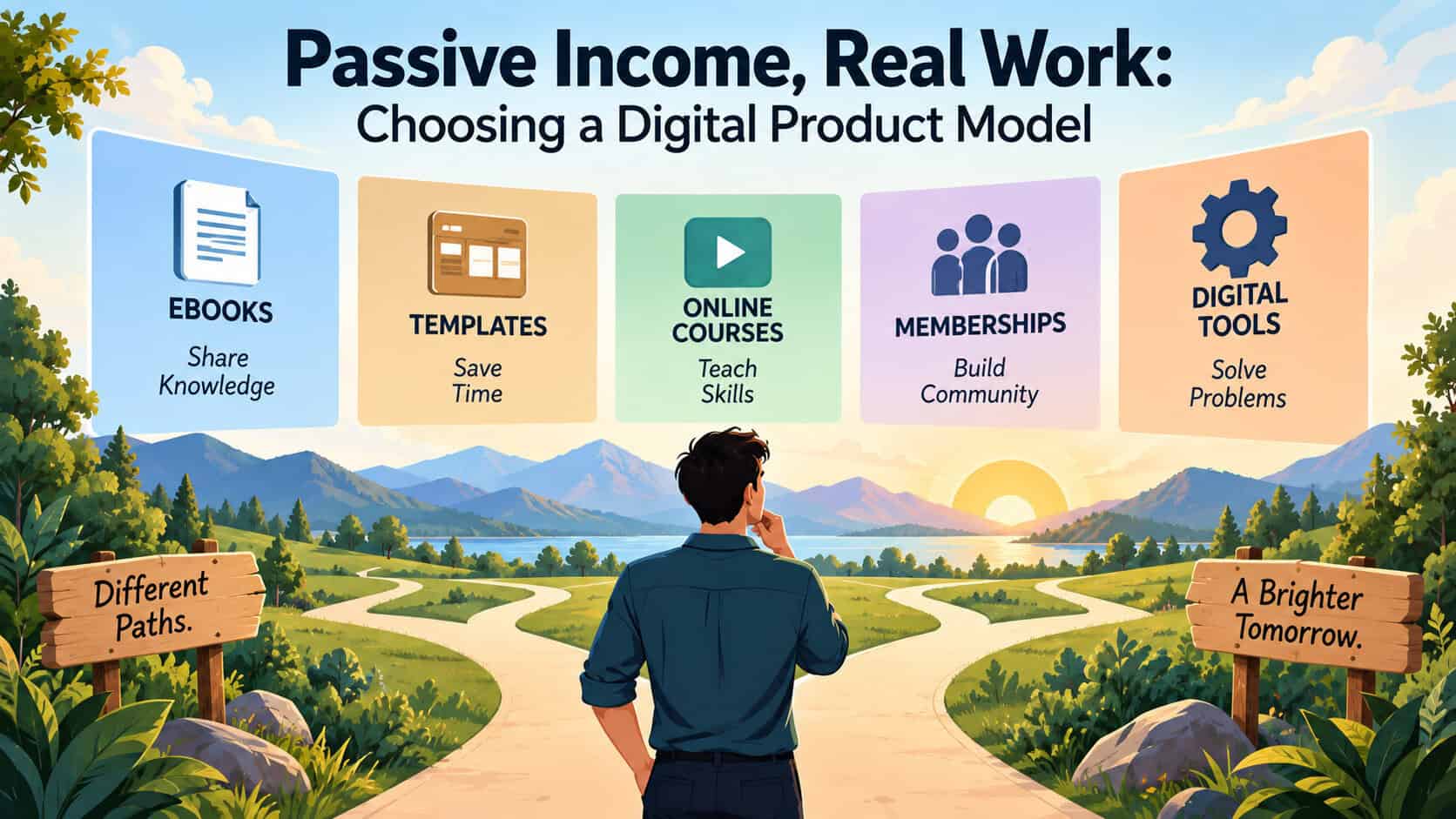
Digital products can be delivered repeatedly without printing, packing, or shipping each order. That makes them attractive to people who want to build an online offer around knowledge, tools, or access.
But “passive” is an easy word to overuse. A course still needs useful lessons. An ebook still needs editing and distribution. A membership still needs ongoing value. An affiliate recommendation still depends on trust, relevance, and a merchant you do not control.
The better question is not which product promises the easiest income. It is which model you can create properly, explain honestly, deliver reliably, and maintain after the first sale.
Start with the asset, not the income promise
Digital-product monetization usually follows one of four routes:
- turning knowledge into structured instruction;
- packaging information or tools as an ebook or download;
- providing ongoing access through a membership;
- making relevant affiliate recommendations alongside a digital-product audience or offer.
Each route creates a different workload. A downloadable file may be simpler to deliver than a membership, but it still needs to solve a real problem. A course can organize expertise into lessons, but customers may need support. An affiliate offer may avoid product creation, but the recommendation still depends on audience fit and clear disclosure.
Digital delivery can reduce the effort required to fulfil an additional order. It does not remove the work of creating something useful, attracting the right audience, handling customer questions, correcting errors, or keeping the offer relevant.
If you are still deciding how a digital product fits into a wider side-hustle idea, see the broader side-hustle foundation. This article focuses on the monetization models themselves.
Four routes for digital-product monetization
1. Courses and structured instruction
A course turns knowledge into a sequence of lessons, exercises, demonstrations, or other learning materials. It can be useful when the customer needs help moving from a question to a skill or finished result.
The work does not end when the lessons are recorded. You still need to check that the material is accurate, explain unclear points, respond to learner questions, and update sections when the subject or supporting tools change.
A course is most suitable when you can explain a process clearly and support the learner through the parts that are easy to misunderstand. It is a poor fit if the offer depends on a promise that the customer will achieve a particular income, career, or business result.
2. Ebooks and downloadable products
An ebook, workbook, checklist, template, or planner can package information into a product that the customer downloads and uses independently.
These products may be easier to deliver than a live service, but quality still matters. The file should be accurate, readable, usable, and clear about what the customer receives. If the product depends on a platform, file format, regulation, or software workflow, those dependencies may require future updates.
Amazon KDP documents its own publishing, pricing, and royalty conditions, but those rules do not prove that a particular book will sell. Pricing should be chosen for the specific market, format, rights position, and distribution channel rather than copied as a universal formula. See the current KDP royalty and pricing guidance before making platform-specific claims.
3. Memberships and recurring access
A membership can provide recurring access to lessons, resources, a community, or continuing support. The recurring payment model can make the commercial relationship ongoing, but it also creates an ongoing responsibility.
Members need a reason to remain subscribed. That may involve new material, useful updates, answers to questions, community moderation, or access to resources that continue to save them time. The exact workload depends on the promise made at signup.
Memberships therefore require more than a checkout page. They require a clear value proposition and a realistic plan for maintaining that value. No membership model guarantees retention, recurring revenue, or business growth.
4. Affiliate marketing connected to digital products
Affiliate marketing is different from creating and selling your own digital product. The creator recommends another company’s product or service and may receive a commission when a reader purchases through a tracked link.
The recommendation should solve a problem that already appears in the article. It should explain what the tool or service does, who might find it useful, and what the reader should check before buying. The merchant’s pricing, terms, features, and availability may change, so avoid presenting them as permanent facts.
A material financial connection must be disclosed clearly. A disclosure also does not make an unsupported earnings, performance, or quality claim acceptable. The FTC endorsement guidance explains why both transparency and truthful claims matter.
Compare the trade-offs before choosing
| Model | What is being monetized | Work after launch | Main dependency |
|---|---|---|---|
| Course | Instruction and guided learning | Support, corrections, and updates | Course quality and learner completion |
| Ebook or download | Information, templates, or tools | File maintenance, support, and discoverability | Product usefulness and distribution |
| Membership | Ongoing access or support | Regular value, member support, and retention | Continued customer value |
| Affiliate-connected offer | Relevant recommendation and audience trust | Link, merchant, and disclosure maintenance | Merchant terms and audience fit |
The simplest model is not automatically the best one. Choose the model that matches what you can keep useful after the initial launch.
Validate the problem without treating interest as proof
Before building a large product, look for evidence that the problem is real and specific.
- Collect recurring questions from the audience you want to serve.
- Compare how people describe the problem, not just how often a keyword appears.
- Review competing products to identify what they explain well and what they leave unclear.
- Test a small sample, outline, worksheet, or lesson before producing the full offer.
- Ask potential customers what outcome they need and what would make the product useful.
Google Trends can help compare relative search interest over time and between topics. It does not prove that people will buy a product, establish the size of a market, or predict revenue.
Validation reduces guesswork. It does not guarantee demand.
Tools and commercial options for digital-product delivery
The tools below have different roles. None of them guarantees sales, conversions, recurring income, or a successful product.
Systeme.io for funnels and follow-up
Systeme.io describes tools for building sales funnels, landing pages, checkout flows, payment connections, email campaigns, and related automation. Those functions may help a creator organize the path from an interested visitor to a delivered product.
It is still the creator’s responsibility to write an honest offer, choose an appropriate product, handle customer questions, and check the platform’s current plans and terms.
Disclosure: Connect may earn a commission if you purchase Systeme.io through this link.
ClickBank and Social Jobs
ClickBank/Social Jobs is retained as an approved commercial option, but it should be treated as a separate external opportunity rather than proof that a digital product will produce income.
Disclosure: Connect may earn a commission if you purchase through this link. The destination is an external offer, not a promise of employment or income. Review its current price, terms, requirements, refund policy, and earnings disclaimer before deciding whether it is suitable for you.
A Connect-owned digital-product example
The Connect Business Finance Planner Bundle is an example of packaging practical planning resources as a downloadable product.
It is presented here as an example of product format, not as evidence that a particular product will sell or generate income. Read the current product page for the included materials, format, price, and usage terms before purchasing.
Choose the model you can maintain
Before committing to a digital-product idea, ask:
- Can I create this to a useful standard?
- Can I explain clearly what the customer receives?
- What support will customers need after purchase?
- Which parts will need updates?
- Am I comfortable with the platform, payment, and marketplace dependencies?
- Can I reach people who have the problem without making exaggerated promises?
A product that is easy to deliver but difficult to keep useful may create more support work than expected. A product that takes longer to build may be worthwhile if it solves a clear problem and can be maintained responsibly.
Frequently asked questions
Are digital products truly passive?
Some digital products can be delivered repeatedly with little additional fulfilment work. They are not automatically passive in the sense of requiring no maintenance, marketing, customer support, or updates.
Which digital-product model is easiest to maintain?
That depends on the promise. A simple downloadable file may require less ongoing support than a membership, while a course may need more learner assistance than an ebook. Choose the model with a clear scope that you can keep accurate and useful.
Is an ebook better than a course?
Neither is universally better. An ebook may suit readers who want a concise reference. A course may suit people who need a sequence of explanations and practice. Choose based on the problem, the material, and the support you can provide.
Do memberships guarantee recurring income?
No. A membership creates a recurring billing structure, but retention depends on whether members continue to see value. Content, support, churn, payment issues, and platform costs all matter.
Can affiliate marketing count as a digital-product business?
Affiliate marketing can be part of a digital-product monetization plan, but it is not the same as creating your own product. The affiliate depends on a merchant’s offer and terms, so relevance, trust, and disclosure are essential.
Does search interest prove that a product will sell?
No. Search-interest data can help with topic research, but it does not prove purchase intent, product-market fit, conversion, or revenue.
What should be disclosed when recommending an affiliate product?
Disclose the material financial relationship clearly and near the recommendation. Keep the claim itself truthful as well. A disclosure does not make an exaggerated earnings or performance claim acceptable.
Final takeaway
The strongest digital-product model is not the one with the most attractive passive-income promise. It is the one whose value you can create, explain, deliver, support, and improve without misleading the customer.
Start with the asset and the customer problem. Compare the maintenance burden. Use tools carefully. Keep commercial relationships visible. Then build only what you can stand behind.