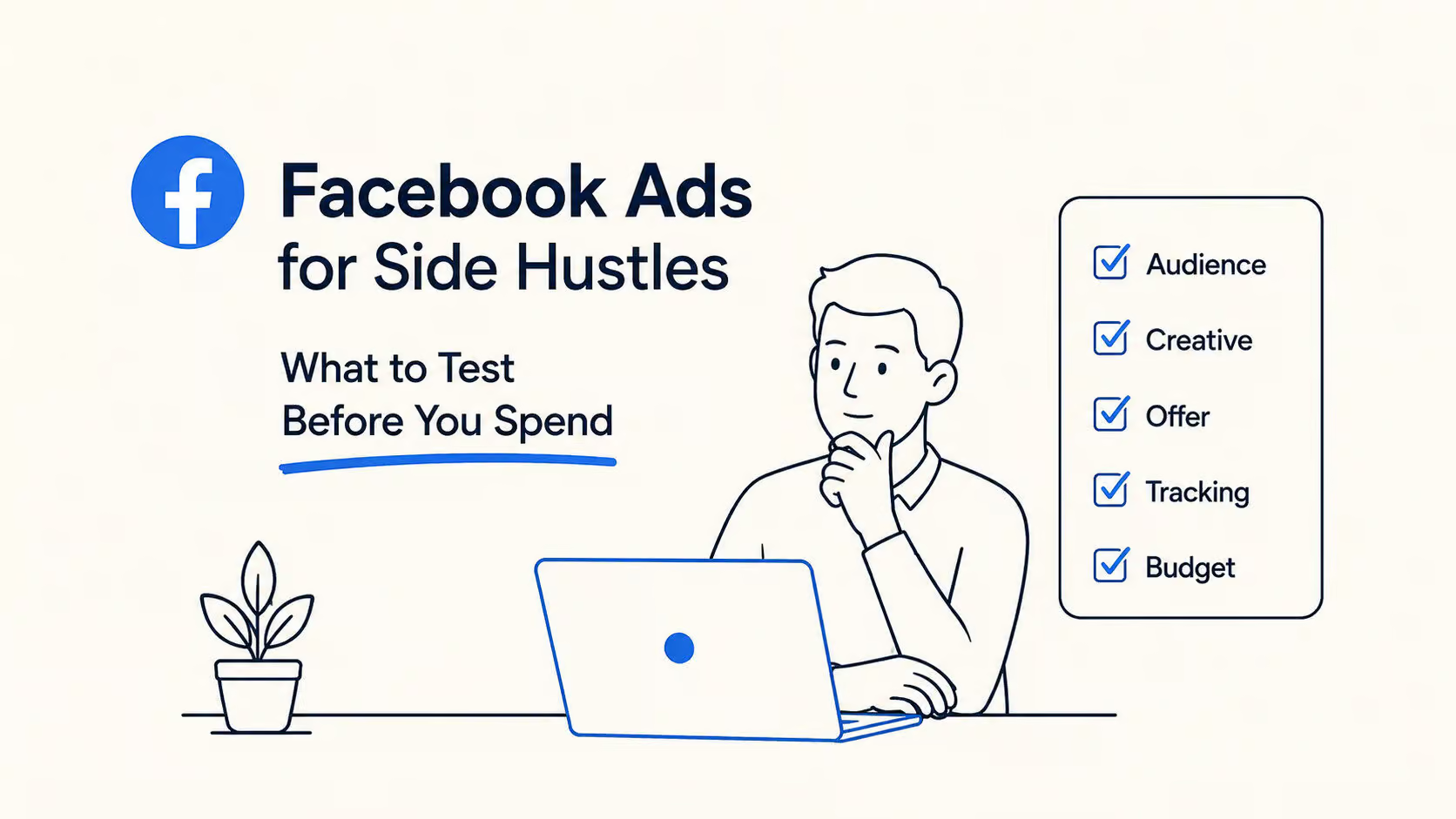
Facebook Ads can help a side hustle reach people beyond its existing audience, but paid reach only works when there is something worth testing behind the click. Before spending, you need a clear offer, a destination that explains it, a way to measure the action you care about, and a limit on how much you are willing to lose while learning.
That makes Facebook Ads for side hustles less about finding a secret targeting trick and more about running a controlled business experiment. The goal is not to “make the algorithm work,” but to learn whether a specific offer, message and audience can produce a result your side hustle can sustain.
When Facebook Ads Make Sense for a Side Hustle
Paid ads are usually easier to evaluate when your side hustle already has a concrete next step: buy a product, request a quote, book a call, join a waitlist, start a trial or complete another measurable action. If the offer is still changing every week or the landing page cannot explain why someone should act, ads can amplify uncertainty rather than solve it.
Before opening Ads Manager, can you answer these questions?
- What are you selling or asking people to do? One campaign should have a clear business outcome.
- Who is it for? Define the problem, use case or buyer situation before choosing targeting controls.
- Where will the click go? The destination should continue the promise made in the ad instead of changing the subject.
- What action counts as success? A purchase, qualified lead or another business-relevant event is more useful than “more engagement” by itself.
- What can you afford to learn? Set a maximum test loss that will not damage the side hustle if the campaign fails.
If several answers are missing, improve the offer, product page or landing page before paying for traffic.
Affiliate disclosure: Connect may earn a commission if you purchase through the Hostinger or Systeme.io links below, at no extra cost to you. We include them only where they match the setup being discussed.
Start With the Business Result, Not the Ad Format
Meta’s current training materials organize campaign setup around objectives, conversion settings, audiences and delivery choices. Choose settings from the business result backward rather than starting with a favorite format or a broad goal such as “get more exposure.”
If the real objective is a sale, measure the path toward a sale. If the offer needs a conversation before purchase, a qualified lead may be the better outcome. If you are validating whether anyone cares about a new concept, traffic can produce information, but a cheap click is not proof that the business works.
This distinction protects side-hustle budgets. An ad platform can optimize efficiently for the selected event even when that result has little business value. The event and business goal need to agree.
Meta Blueprint’s campaign optimization training covers selecting objectives, conversion settings, audiences and delivery based on campaign goals.
Build an Audience Hypothesis, Not a Perfect Customer Avatar
Audience planning matters, but it is easy to over-engineer it. A side hustle rarely knows enough at the beginning to define a perfect buyer through a long list of interests and demographic assumptions.
Start with a defensible hypothesis. Describe the situation that makes someone likely to need the offer. Then use the audience controls available in Meta to test that hypothesis without assuming that narrower always means better. Meta’s current audience training covers new audiences, Custom Audiences, Lookalike Audiences and Advantage+ audience options, so the platform itself now supports several levels of manual and automated discovery.
For a small operator, the useful question is not “How many targeting filters can I add?” It is “What audience assumption am I trying to test, and what evidence would make me change it?”
If you have legitimately collected customer or subscriber data, Custom Audiences may help you reach people with an existing relationship to the business. Otherwise, do not invent data or scrape lists; start with audience information you can defend.
Make the Creative Carry One Clear Promise
An ad earns attention before it earns a click. The creative should make one clear promise that the destination can keep. That usually means aligning three things:
- The hook: why this is relevant now.
- The value: what problem, outcome or use case the offer addresses.
- The next step: what the person should expect after clicking.
Do not manufacture proof. A fake testimonial, invented revenue screenshot or exaggerated performance claim may improve short-term curiosity while creating a bigger trust and compliance problem. The U.S. Federal Trade Commission states that endorsements must be truthful and not misleading, and that material relationships between endorsers and marketers should be disclosed where they could affect how people evaluate the endorsement.
If you use a real customer testimonial in an ad, use it with permission, represent the customer’s experience accurately, and make required disclosures clear rather than hiding them behind vague wording.
FTC endorsement guidance is a useful baseline for testimonial and endorsement integrity.
Fix Measurement Before You Try to Optimize
Optimization depends on measurement. Before launch, decide which system answers each question.
- Meta Ads Manager shows delivery and platform-attributed campaign results.
- Your site analytics can show what visitors did after arriving and how paid traffic compares with other channels.
- Your store, CRM or payment system is often the strongest source for actual orders, qualified leads and revenue.
These systems may report different numbers because of attribution windows, consent, browser limitations, cross-device behavior and modeling. Treat discrepancies as measurement questions, not proof that one dashboard is wrong.
For website campaigns, Meta provides browser-side and server-side measurement through tools including the Meta Pixel and Conversions API. Server-side event sharing can strengthen data flow, but it does not create perfect attribution or remove the need for privacy-aware implementation.
It is also useful to tag destination URLs consistently. Google Analytics documents UTM campaign parameters such as utm_source, utm_medium and utm_campaign so campaign traffic can be identified in acquisition reporting. Consistent naming makes later comparisons much easier.
Google Analytics campaign URL guidance explains how UTM parameters feed campaign reporting.
Define the Test Before You Define the Budget
There is no universal daily budget for every side hustle. A useful test budget depends on the offer’s price and margin, expected customer value, optimization event, audience size, delivery costs and how much you can afford to lose while learning.
Instead of asking, “What is the minimum I should spend?”, define the experiment:
- Write the learning question. Example: “Does this value proposition produce qualified leads from this audience?”
- Choose the business outcome. Decide what event will determine whether the test matters.
- Choose the variable. If you are trying to learn what caused a difference, change one important variable at a time.
- Set the loss limit. Decide in advance how much you can spend without needing the test to succeed.
- Set the decision rule. Define what would make you stop, repair the funnel or continue testing.
Meta Blueprint teaches A/B testing as a way to compare ad strategies and creative variables. For a side hustle, the value of that discipline is not statistical theater. It is avoiding the common mistake of changing the audience, creative, offer and landing page at the same time and then having no idea what caused the result.
Meta Blueprint’s creative-testing course covers A/B tests and measurement for ad creative.
Use Business Metrics to Read the Result
Clicks, click-through rate and cost per click can help diagnose what happened, but they are not the finish line. A side hustle needs to connect ad delivery to the action that creates value.
Google Analytics calls actions that are particularly important to the business key events. Depending on the business, that could be a purchase, completed lead form, booked call or another defined action. Thinking in those terms prevents vanity metrics from becoming the campaign goal by accident.
Google Analytics guidance on key events explains how important business actions can be measured across channels.
For a paid campaign, a practical reading sequence is:
- Was the ad delivered? If delivery is weak, first check campaign setup, audience constraints, approval status and budget.
- Did the creative earn attention and clicks? If not, the message or creative may be the first bottleneck.
- Did visitors take the promised next step? If clicks are healthy but the destination does not convert, inspect offer-message alignment, page clarity, trust and checkout or lead-flow friction.
- Did the result make economic sense? A campaign can generate conversions and still be unprofitable.
Know When to Stop, Fix or Continue
| What you observe | Likely next question | Practical response |
|---|---|---|
| Little or no delivery | Is the campaign constrained or misconfigured? | Check objective, audience, approvals, schedule and budget before judging the offer. |
| Delivery but weak response | Is the creative/message relevant? | Test a materially different hook, value proposition or creative concept. |
| Clicks but few business actions | Does the destination continue the ad promise? | Inspect landing-page clarity, offer strength, trust, speed and checkout/lead friction. |
| Business actions but poor economics | Is acquisition cost sustainable? | Review margin, customer value, price, conversion rate and campaign efficiency before adding spend. |
| Repeatable actions at acceptable economics | Can the result survive more volume? | Increase cautiously, monitor quality and keep a rollback point instead of assuming scale will be linear. |
The important word is repeatable. One good day is evidence, not a business model. One bad day is also not enough to diagnose every campaign. Use the decision rules you defined before launch and look for patterns that matter to the economics of the side hustle.
Common Facebook Ads Mistakes for Side Hustles
Running ads before the offer is clear
Paid traffic cannot rescue an unclear offer. If the landing page still needs basic explanation, fix it before buying more visits.
Optimizing for the easiest metric instead of the valuable one
Cheap clicks or high engagement can feel reassuring while revenue or qualified leads stay flat. Use diagnostic metrics to understand the funnel, but let business outcomes determine whether the campaign deserves more money.
Changing too many variables at once
Changing the creative, audience, destination and offer together may improve the campaign but teaches you little. Controlled testing makes the next decision clearer.
Using fake urgency, fake proof or unrepresentative results
Do not trade trust for short-term attention. Use claims you can support, and clearly disclose material connections in endorsements.
Scaling because a dashboard turns green
Treat platform-reported performance as one input. Check real orders, lead quality and margins before increasing risk.
A Simple Pre-Launch Checklist
- The offer and destination make the same promise.
- The campaign has one primary business outcome.
- Tracking is tested before launch.
- Campaign URLs use a consistent UTM convention where appropriate.
- The audience hypothesis is written down.
- The creative makes an honest, supportable claim.
- The test has a defined learning question.
- The maximum acceptable loss is set in advance.
- Stop, fix and continue rules are written before results arrive.
Frequently Asked Questions About Facebook Ads for Side Hustles
How much should a side hustle spend on Facebook Ads?
No universal daily budget fits every business. Start with what you can afford to lose while learning, then check whether it allows a realistic test of the business action you care about. If the required test budget exceeds your safe limit, do not force the campaign.
Should I run Facebook Ads before I have sales?
Ads can in principle test demand, but before the offer and destination are proven the interpretation is far harder and organic validation is usually cheaper. For most side hustles, validate the offer first; if you intentionally use paid traffic earlier, treat it as a bounded learning experiment rather than a scaling campaign. Paid traffic is most useful when you know what question the spend is supposed to answer.
What is the most important Facebook Ads metric?
The most important metric is the one connected to the business outcome you are trying to create. Clicks, CTR and cost per click can diagnose the path, but purchases, qualified leads or another defined key action determine whether the campaign is creating value.
When should I scale a Facebook Ads campaign?
Scale only after the campaign produces repeatable business actions at economics you can accept and after you have checked that the underlying conversion data agrees with real orders or lead quality. Increase risk gradually and keep monitoring because performance at a larger budget is not guaranteed to match the smaller test.
The Bottom Line
Facebook Ads can be useful for a side hustle, but they are not a substitute for a clear offer or sound economics. Treat paid traffic as a controlled experiment: define the business result, measure the full path, cap the downside, test deliberately and make the next decision from evidence rather than excitement.
If the campaign fails, the useful outcome is not “Facebook Ads do not work.” It is a more specific diagnosis: the audience hypothesis was weak, the creative did not earn attention, the destination broke the promise, the offer did not convert, the tracking was unreliable, or the acquisition economics did not fit the business. That is the kind of lesson a side hustle can use.