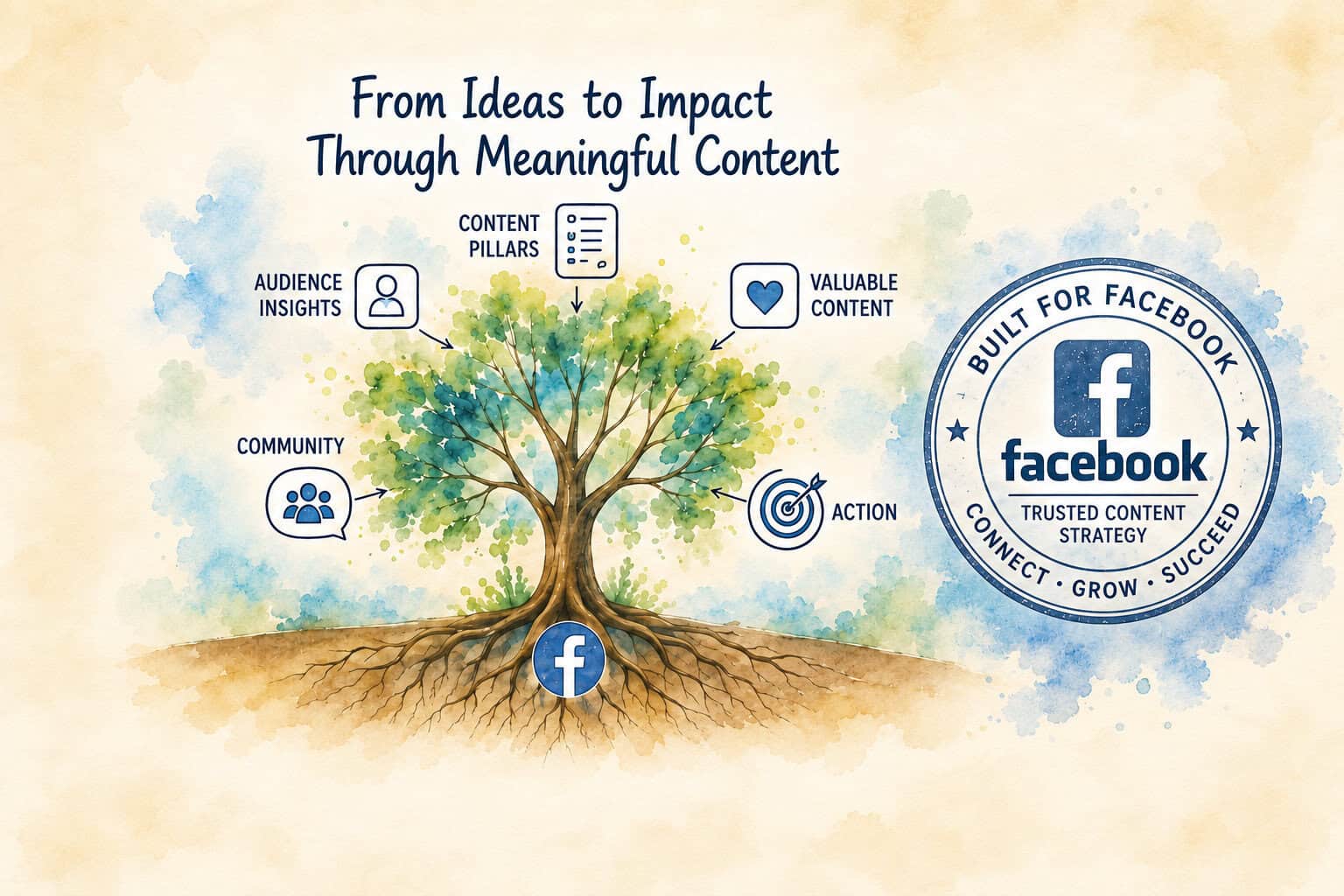
A Facebook content strategy is the set of choices that keeps a Page from becoming a pile of unrelated updates. It decides what your audience should learn, see, discuss, and eventually act on—and how those choices connect from one post to the next.
The Jab-Hook idea gives that planning a useful tension. Most posts should create context before a sales request appears: teach something, demonstrate something, or start a relevant conversation. The hook is the moment you make the next step clear. The method is useful because it forces you to think about sequence and relevance, not because there is a universal posting ratio.
Instead of filling a calendar first, build a small set of audience-led themes, decide which ideas are jabs and which are hooks, choose the format that best carries each idea, and review whether the mix is becoming more useful over time.
Use the Jab-Hook Method as a Planning Principle
Before asking “How many times should I post?”, decide what kind of value should come before the ask. A useful Facebook plan normally needs several kinds of jabs because people do not arrive with the same question or level of familiarity every time they open the app.
Use four simple roles when you sketch the mix:
- Teach — jab: answer a question, explain a process, or remove a small point of confusion.
- Show — jab: demonstrate the work, product, process, or evidence behind a claim.
- Converse — jab: invite a specific discussion that reveals what the audience cares about or needs next.
- Invite — hook: make a relevant next step clear when there is something worth buying, booking, downloading, or exploring.
A local service company may lean toward demonstrations and questions. A digital-product brand may lean toward teaching and walkthroughs. The point is not to balance four boxes perfectly. It is to avoid a feed where every update asks for attention or money without first creating enough context to make the ask meaningful.
Build Content Pillars From Real Customer Questions
Content pillars are recurring subject areas that make planning easier. They should come from your business and your audience—not from a generic list of “viral ideas.”
Start by collecting the questions and friction you already see:
- questions customers ask before buying;
- common objections or misunderstandings;
- steps people struggle with after they buy;
- comments and messages that reveal what people want to know;
- product uses that are easier to understand when shown;
- small decisions your audience repeatedly has to make.
Then group those into three to five themes you can return to without repeating the same post. For example, a small fitness studio might use “how to begin,” “exercise technique,” “member routines,” and “class decisions” as pillars. A digital-product business might use “choosing a product,” “building the offer,” “selling the asset,” and “improving the system.”
A strong pillar is broad enough to generate many useful posts but specific enough that the right audience recognizes it as relevant.
Match the Format to the Message
Do not choose a format only because someone says the algorithm “loves” it. Start with what the message needs.
- Use a short video or Reel when movement, demonstration, personality, or before-and-after context matters.
- Use an image when one visual can carry the idea quickly.
- Use text when the value is in the explanation, opinion, question, or story.
- Use a sequence of visuals when the idea is easier to understand step by step.
One current platform principle is especially important: originality. Meta says Facebook is placing more emphasis on original content in Feed and Reels while deprioritizing duplicative or low-value reused material. In practice, that means your content plan should favor material your business actually creates or meaningfully transforms instead of filling the calendar with recycled posts that add little. Meta’s 2026 original-content guidance explains the distinction.
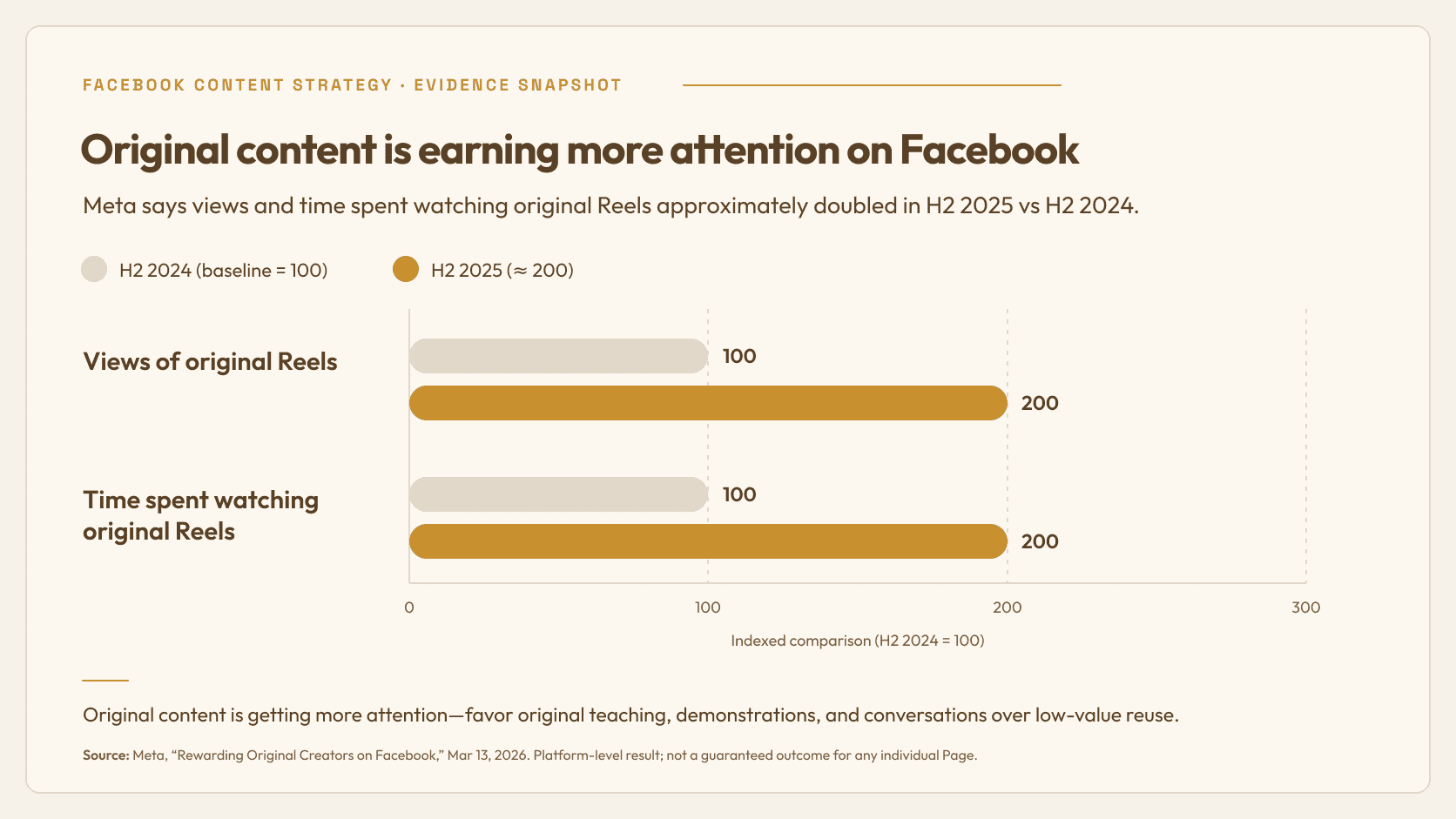
Choose video when it improves the explanation; otherwise, use the format that carries the idea most clearly.
Build a Jab-Hook Content Board
Once the pillars are clear, put ideas on a small content board before assigning dates. This keeps the sequence visible: are you teaching, showing, and conversing enough to make the next hook feel relevant, or has the Page become a line of disconnected promotions?
A practical board can use five columns:
| Jab / hook role | Pillar | Idea | Format | Primary signal |
|---|---|---|---|---|
| Teach — jab | Customer question | Answer one common beginner problem | Text or short video | Useful comments, saves, watch time |
| Show — jab | How it works | Show a real process or demonstration | Video or image sequence | Completion, clicks, questions |
| Converse — jab | Community | Ask about a real choice your audience makes | Text, image, or video | Relevant replies |
| Invite — hook | Product or service | Explain who the offer is for and the next step | Format that shows the offer clearly | Qualified clicks or inquiries |
Only after the board makes sense should you assign dates. Choose a cadence you can sustain without lowering the quality of the ideas. Consistency is useful when it protects a coherent content mix; frequency by itself is not the strategy.
Affiliate disclosure: Connect may earn a commission if you purchase through the Hostinger, Systeme.io, or Social Jobs links in this article, at no extra cost to you. They are included because they support parts of the content-to-offer system discussed here.
Build Community Without Manufacturing Engagement
“Ask a question” is not a strategy by itself. Good community content gives people a reason to answer because the question is connected to something they actually care about.
Instead of posting “What do you think?” under every update, ask specific questions that can improve your next piece of content or reveal a customer preference. If you sell templates, ask which part of a workflow takes the most time. If you run a local service, ask what people find hardest about choosing between two common options. Then use the answers.
The second half of community content is response. Read comments, answer useful questions, clarify misunderstandings, and notice repeated themes. Your audience is giving you research in public. A content strategy gets stronger when those signals shape the next planning cycle.
Measure Each Post by Its Intended Role
One of the easiest ways to make bad content decisions is to judge every post by the same number. A teaching post, a demonstration, a conversation prompt, and a hook do not deserve the same scorecard.
Choose a primary signal that fits the role:
- Teach: useful comments, saves where available, watch time, completion, or follow-up questions.
- Show: watch time, clicks, Page actions, and questions that indicate the demonstration was understood.
- Converse: relevant replies and the quality of the discussion, not simply reaction count.
- Invite: qualified clicks, inquiries, leads, or sales you can actually attribute.
Meta is increasingly building creator tools around account-specific performance and audience signals rather than one universal formula. Its 2026 Creator Assistant announcement describes recommendations based on a creator’s own content, performance, engagement trends, and community; availability is still limited by rollout. The broader lesson is useful even without that feature: compare your own posts with similar posts from your own account, then make the next decision from that evidence.
Keep Organic Content Separate From Paid Facebook Advertising
Organic content and paid ads can support the same business, but they are not the same operating system.
Your organic Facebook content strategy should answer questions such as:
- What does our audience need to understand?
- Which topics deserve recurring coverage?
- Which formats communicate those ideas best?
- What conversations should we learn from?
- Which organic signals tell us what to repeat or change?
Paid advertising has a different set of decisions: campaign objectives, budgets, targeting controls, conversion tracking, bidding, creative testing, and paid optimization. Keeping those decisions separate prevents an organic content plan from turning into an unfocused advertising guide.
Audit the Content Mix, Not Just Individual Winners
A Facebook content strategy is a portfolio, not a contest to find one winning post and copy it forever. After you have enough comparable posts to see patterns, review the mix by role, pillar, and format.
- Which teaching posts repeatedly produce useful follow-up questions?
- Which demonstrations make the product, service, or process easier to understand?
- Which conversations reveal a real audience need instead of collecting empty reactions?
- Do hooks appear after enough useful context, or do they arrive abruptly?
- Which pillars still have fresh questions to answer, and which ones are being stretched thin?
- Which formats consistently make a particular kind of idea clearer?
Use those patterns to reshape the board. Expand themes that keep producing useful questions, rework ideas that were unclear, and park formats or topics that add activity without adding understanding. The review rhythm can be weekly, monthly, or tied to your publishing volume; what matters is comparing like with like instead of reacting to one isolated spike.
A Facebook Content Strategy Should Make the Next Post Easier
The strongest content plan is not the one with the most categories, the busiest calendar, or the most complicated framework. It is the one that helps you decide what to publish next with less guessing.
Use the Jab-Hook roles deliberately. Build pillars from real customer needs. Choose the format that fits the message. Favor original, useful content over filler. Review the mix according to what each role was meant to accomplish, then reshape the board from what you learned.
That turns Facebook from a stream of disconnected updates into a content system your business can actually improve.