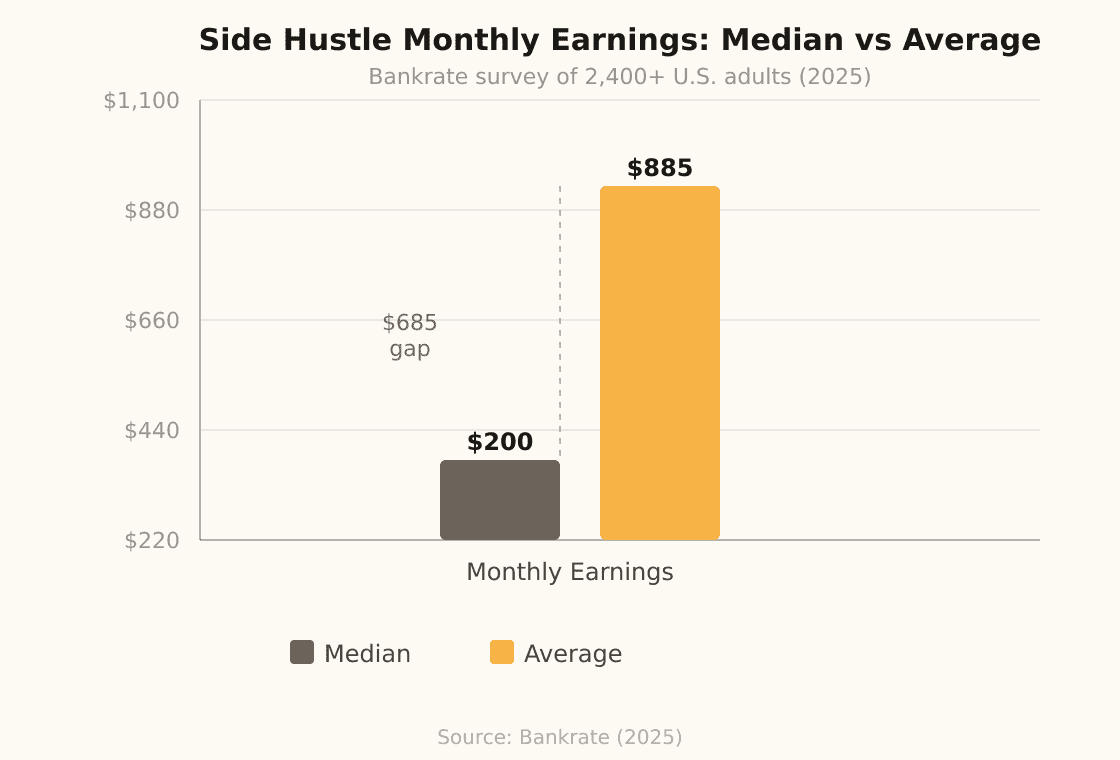
In 2025, 27% of American adults were running a side hustle, yet the numbers tell two very different stories. The median earner brought in $200 a month. The average pulled in $885 (Bankrate, 2025). That $685 spread between the typical earner and the mean is where this guide starts.
A descriptive survey can’t tell us why the gap exists — it only measures it. Those two figures show that the reported median and average are far apart, but they do not reveal the underlying shape of the earnings distribution or explain why the gap exists. This guide uses that spread as context, not as causal evidence. Its practical framework is the order of decisions: validate first, build second, market third. The claim is narrower than the survey data: sequencing can reduce avoidable work and spending before demand is clear; it does not prove why one person earns more than another.
This guide walks through the sequence in practice: what a side hustle actually requires, how to find a niche that has real buyers, what a first offer looks like, whether brand matters before revenue, and what structural advantage an owned email list offers over rented distribution.
What Does Building a Successful Side Hustle Actually Require?
The $685 spread between the median and the average is the number this guide is built around. Bankrate’s survey of more than 2,400 adults found median monthly earnings of $200 against an average of $885 (Bankrate, 2025). The survey measures the gap; it doesn’t explain it. This section presents the practical argument the rest of the guide uses: validate demand before building an offer, then grow a channel around something people have shown they want. That is editorial guidance, not an explanation supplied by the Bankrate survey.
Effort matters, but sequence affects how much of that effort is spent before demand is clear. The framework here is to validate an audience, build a specific offer for that audience, then grow a channel you own. That sequence is a risk-reduction principle, not a promise that following it will move someone from Bankrate’s median toward its average.
The cost of the wrong order is easy to underestimate. Buying a large course bundle before confirming that anyone wants what you plan to sell feels like progress. It converts into the feeling of progress, not income — the work happens before the demand exists to absorb it. Failure data says the same thing at a much larger scale: among 431 venture-backed companies that shut down since 2023, 43% cited poor product-market fit among their reasons for failure (CB Insights, 2026). To be clear about what that evidence is: startup data, not side-hustle data — funded companies have longer runways and higher stakes. That evidence should not be treated as a side-hustle failure model: venture-backed startups differ sharply in capital, team size, time horizon, and risk. The useful takeaway is narrower — confirming demand before building is a prudent way to reduce the risk of creating something the intended audience does not want.
So the requirement is threefold, and the order matters: a validated audience, a specific offer for that audience, and an owned channel to reach them repeatedly. Everything else — tools, branding, paid ads — sits on top of those three.
How Do You Find a Niche That Actually Has Buyers?
A workable niche sits at the intersection of three things: a skill or knowledge you actually have, a problem a specific group actively talks about, and enough search demand to build organic reach. If one is missing, the niche may be harder to sustain or harder to grow. The startup evidence in the last section reinforces a narrower validation principle: confirm that a specific audience has a real problem before investing heavily in an offer.
Consider the difference specificity makes. “Online marketing” is broad enough that many different sites can target overlapping searches. “Email marketing for independent bookstores” is far more specific, which can reduce direct competition and make the intended audience easier to recognize in the headline, depending on the market. The narrower frame may reach fewer people overall, but it can improve relevance for the buyers you actually want to serve.
The cheapest validation is listening before building. Find where your future buyers already gather — Facebook groups, subreddits, niche forums, comment sections — and read what they complain about. Recurring complaints, stated in the audience’s own words, are your first content topics and your first product questions. You are not guessing what people want; you are writing down what they already said.
Three questions to test any niche before committing: Is there a community already discussing this problem? Are people actively searching for solutions? Would they pay for a better answer than what’s free? Three yeses are a useful signal that the niche is worth testing. If demand is uncertain, a low-overhead digital product is a reasonable way to test the water before committing to a service — see passive income through digital products for that path.
What Does a First Offer Look Like?
Validation gives you two things: a specific audience and a list of their complaints, in their words. The first offer is the smallest useful thing that answers the most common complaint. Not the most ambitious thing — the smallest one that genuinely helps.
Define it in four lines before you build anything. What it is: one deliverable, not a platform. Who it’s for: the validated group, named narrowly. The outcome: the specific complaint it removes. The format: whichever you can finish in weeks — a done-for-you service, a template pack, a short practical guide — rather than the format that sounds most impressive.
Price it against the value of the problem removed, not against your production time, and expect to adjust once real buyers respond. The number itself matters less at this stage than the signal: one sale, or concrete purchase intent (waitlist commitments, pre-orders, people asking “can I pay you for this?”), is an early validation signal that the offer may be worth developing further. Expansion — more formats, higher tiers, automation — comes after that signal, not before it. An offer nobody has paid for yet is still a hypothesis; treat it like one.
Does Brand Matter Before You Have Customers?
Yes — but not in the way beginners usually spend on it. Brand trust is a purchase criterion on par with quality and value: 88% of consumers say that trusting a brand is an important or critical factor when deciding what to buy (Edelman Trust Barometer, 2026). When two options look similar, trust can become one factor in the decision — an editorial interpretation of the survey finding, not a claim that the Edelman report proves trust is always the deciding factor.
A professional logo before your first customer may improve presentation, but it does not validate demand. A practical early-stage brand approach is to make three things clear: what you stand for, who you help, and why your offer is credible. Keep those answers consistent while you gather real customer feedback; refine the visual identity as evidence accumulates instead of treating design spend as proof of market fit.
At this stage, your brand is three answers: what you stand for, who you help, and why you over the alternatives. Pair those answers with a consistent presence on one or two channels rather than everywhere at once. Good social media marketing strategies at this stage are about reliability, not coverage.
Which Marketing Channel Builds the Most Durable Asset?
Email has one structural advantage over social platforms: it gives you a direct subscriber list that is not dependent on a single social feed for distribution. MailerLite’s benchmark data puts the median open rate at 43.46% and the median click rate at 2.09% across the accounts it measures (MailerLite, December 2025). Read those open rates as directional rather than exact — Apple Mail’s privacy features preload images and inflate open counts, so the click rate is the more honest signal. Those figures are email benchmarks, not proof that email outperforms every social channel. The stronger argument is ownership: you retain the subscriber relationship and can move your list between email providers, although inbox placement still depends on sender reputation and email-provider filtering.
Paid social works differently, and it’s worth understanding the difference early. A short, well-targeted paid test can tell you whether an offer converts — that’s genuinely useful data. But direct paid traffic is rented: when campaign spend stops, that paid traffic usually drops with it. Email behaves differently because the subscriber list remains available for future sends. A single free resource, built directly from the complaints and questions you collected during validation, can help grow a list without requiring paid acquisition. And because subscribers opted in, each send lands with people who already raised their hand — which is why more specific welcome content can improve relevance and conversion when it answers what subscribers actually asked for.
None of this makes paid advertising worthless. Paid campaigns can perform well — but strong returns assume you already know your audience, your offer, and your message. Paid traffic amplifies what works. It doesn’t create what isn’t working yet. When you do reach the paid stage, how to use Facebook ads for side hustles covers the mechanics in depth.
For building the list itself, a free tier of a tool like Mailchimp or MailerLite keeps the barrier low. You don’t need automation sequences on day one. You need a signup form, a reason to sign up, and a habit of emailing. The practical mechanics — email marketing for small businesses — are covered in depth in that guide.
Frequently Asked Questions
What is the biggest mistake people make when starting a side hustle?
Skipping validation. Most people build before confirming that anyone wants it. The fix costs nothing: find where your target audience talks online, read their complaints, and check whether your idea solves any of them. If your idea never comes up naturally in those conversations, that’s your answer before you spend a dollar.
How many hours per week does a side hustle actually require?
There’s no honest fixed number — it depends on the type. Content-based hustles (blogging, newsletters, digital products) compound: early hours build assets that keep paying later. Service hustles like freelancing are linear: income tracks hours directly. The useful planning question isn’t “how many hours” but “which hours can I protect every single week” — consistency beats volume early on.
What metrics should I track in the first 90 days?
Three: email subscriber growth (are people finding you?), open and click rates (do they trust you enough to engage?), and conversion rate on your primary offer (does trust turn into sales?). Treat most other metrics as secondary until those three show a clear trend.
Does niche selection really change outcomes that much?
Often, yes — but not automatically. A narrower niche — email marketing for independent bookstores rather than “online marketing” — can make your content more specific and may reduce direct competition, depending on the market. The trade-off is a smaller addressable audience, so the goal is not to narrow forever; it is to become specific enough that the right buyers immediately recognize the problem you solve.
When does paid advertising make sense?
After your offer converts without it. Paid traffic before validation spends money to learn a lesson that community listening teaches for free. Run organic and email first, confirm your conversion rate, then use paid to scale what’s already working.
The $200 median and $885 average are context, not income targets this framework can promise to close. The practical argument of this guide is narrower: sequencing can reduce avoidable work before demand is clear. Validate that a specific audience wants a specific answer before you build. Shape the smallest useful offer for them, not for everyone. Then build one channel you own, and let paid traffic amplify what already converts. If you take one step this week, make it listening: find where your future buyers already talk, and write down, in their words, what they complain about. Every other decision in this guide gets easier once you have that list.